
Free Cisco 350-501 Study Guides Exam Questions and Answer
350-501 Exam Dumps, 350-501 Practice Test Questions
Cisco 350-501 exam is intended for IT professionals who are interested in pursuing a career in service provider networking. 350-501 exam is particularly relevant for network engineers, network architects, and other IT professionals who are responsible for designing, implementing, and operating service provider networks. 350-501 exam is also suitable for those who are interested in gaining a deeper understanding of service provider networking and want to enhance their IT skills.
NEW QUESTION # 175
A network engineer must implement SNMPv2 with these parameters:
- Enable SNMP community string C1sc0 with read-only permissions.
- Enable interface index persistence.
- Restrict the SNMP community to only the monitoring server with IP
address 198.18 19 100/32.
- Provide view-only access to ospflfEntry and ospfNbrEntry.
Which configuration must the engineer apply?
- A.
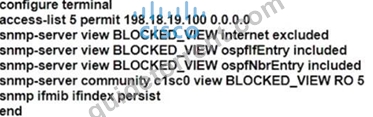
- B.
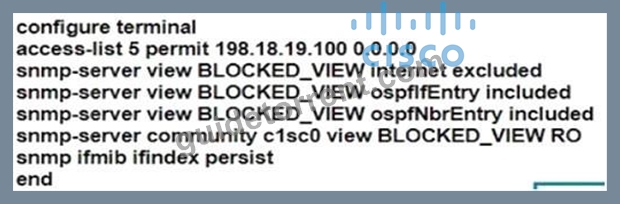
- C.
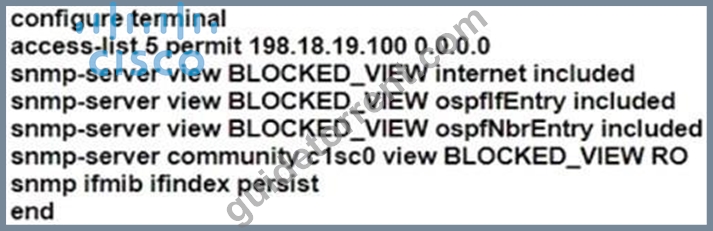
- D.
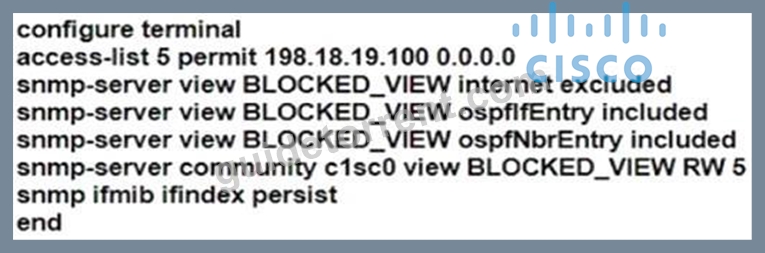
Answer: C
NEW QUESTION # 176 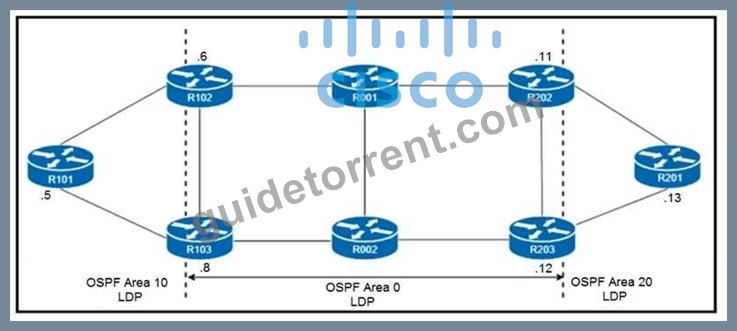
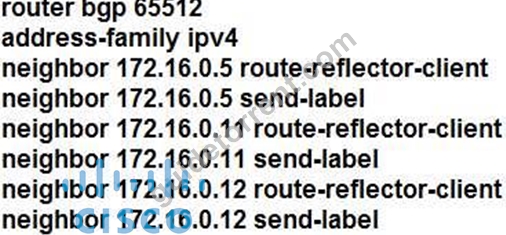
Refer to the exhibit. R101 is peering with R102 and R103, and R201 is peering with R202 and R203 using iBGP Labeled Unicast address families. The OSPF area 0 border routers are in a full iBGP Labeled Unicast mesh, and VPNv4 routes are exchanged directly between PE routers R101 and R201 through iBGP. Which address family-level configuration must be applied on ABR R102 on ABR R102 to support a Unified MPLS routing architecture with partitioned IGP domains?
- A.
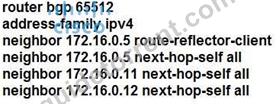
- B.
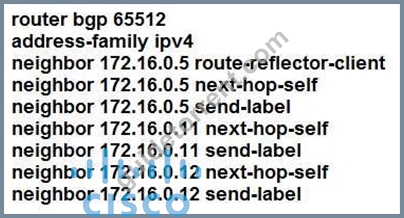
- C.
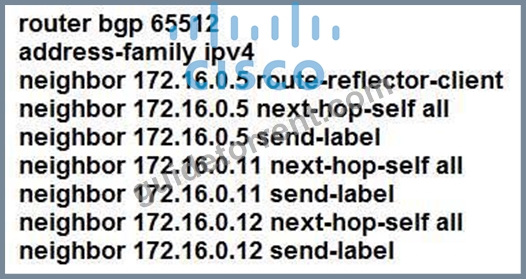
- D.
Answer: D
Explanation:
Section: Services
NEW QUESTION # 177 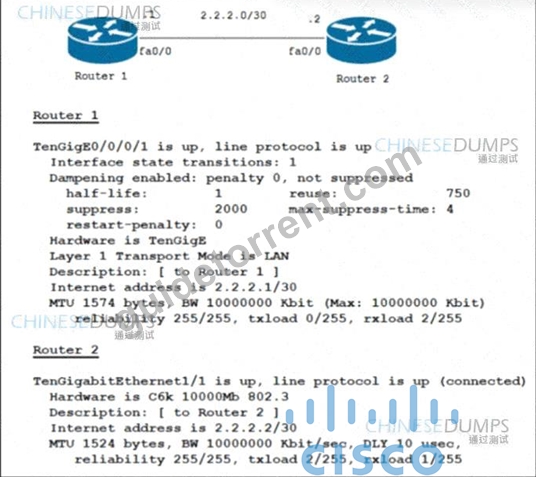
Refer to the exhibit. Router 1 and Router 2 were installed in the data center. Router 1 is the core router in the network, but it fails to establish an OSPF peering with Router 2. and customer traffic is unable to pass. Router
1 also reports an increase in CPU and memory usage. However, the CPU for R2 is stable. Which action resolves this issue?
- A. Disable Cisco Express Forwarding on Router 2.
- B. Enable MPLS on Router 2.
- C. Change the MTU to 1524 on Router 1.
- D. Change the transport mode to WAN on Router 1.
Answer: C
Explanation:
The issue of Router 1 failing to establish an OSPF peering with Router 2, and the increase in CPU and memory usage can be attributed to a mismatch in MTU (Maximum Transmission Unit) sizes. In OSPF, for a successful adjacency to be formed, the MTU size on the interfaces that are trying to form this adjacency must match. In this case, changing the MTU to 1524 on Router 1 will make it compatible with Router 2, allowing OSPF peering to be established and customer traffic to pass through successfully.
Implementing and Operating Cisco Service Provider Network Core Technologies (SPCOR) - Cisco
NEW QUESTION # 178
What causes multicast traffic to permanently stay on the shared tree and not switch to the source tree?
- A. SSM range is being used.
- B. The SPT threshold is set to infinity.
- C. The RP IP address is configured incorrectly.
- D. The RP announcements are being filtered.
Answer: D
Explanation:
https://www.cisco.com/c/en/us/td/docs/ios/solutions_docs/ip_multicast/White_papers/mcst_ovr.html
NEW QUESTION # 179
Refer to the exhibit.
An engineer applied a gRPC dial-in configuration on customer's router to provide connection multiplexing and two-way streaming. What does this configuration accomplish in a gRPC?
- A. It excludes the encapsulation types gpbcompact and gpbkv.
- B. It specifies the encapsulation that is used tor daily and dial-out.
- C. It specifies the encapsulation pushed by the client.
- D. It specifies the encapsulation pushed by the server.
Answer: D
NEW QUESTION # 180
Refer to the exhibit.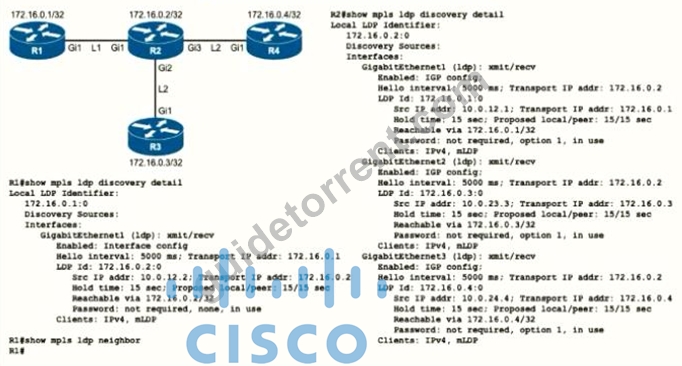
An engineer began to configure LDP between R1 and R2, but R1 and R2 cannot yet establish an LDP TCP connection. Which additional task must be completed to finish the implementation?
- A. Configure the mpls Idp neighbor 172.16.0.1 password command on R1
- B. Configure the mpls Idp neighbor 10.0.12.1 password command on R1
- C. Configure the no mpls Idp password option 1 command on R2
- D. Configure the no mpls Idp password option 1 command on R1
Answer: A
NEW QUESTION # 181
Refer to the exhibit.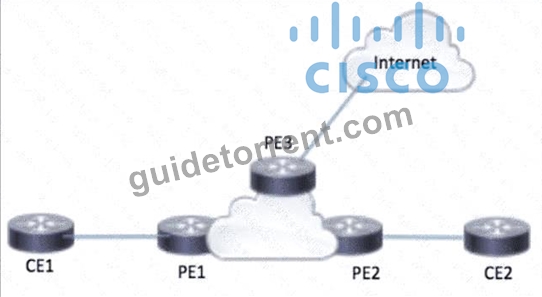
CE1 and CE2 require connectivity to the internet through the ISP connected to PE3 What should an engineer configure to complete this task?
- A. CE1 and CE2 must be configured to use a static default route with a next-hop of PE3 to reach internet routes.
- B. PE1 must be configured with an import route target in the CE1 VRF that matches the export route target for the internet VRF on PE3.
- C. CE1 and CE2 must be configured with a route distinguisher in the PE1 VRF that dynamically imports the route from the internet.
- D. PE2 must be configured to serve as a route reflector for PE3 routes learned from the internet. PE2 then shares the routes with CE1 and CE2.
Answer: A
Explanation:
In this scenario, CE1 and CE2 need connectivity to the internet through the ISP connected to PE3. The most straightforward approach is to configure CE1 and CE2 with a static default route pointing to PE3 as the next- hop for internet-bound traffic. This ensures that any traffic destined for the internet will be routed directly to PE3, which is directly connected to the internet. Other options (A, B, and D) involve more complex configurations and are not necessary for this specific task. References: Implementing and Operating Cisco Service Provider Network Core Technologies source documents or study guide
NEW QUESTION # 182
SIMULATION 7
Guidelines
This is a lab item in which tasks will be performed on virtual devices.
- Refer to the Tasks tab to view the tasks for this lab item.
- Refer to the Topology tab to access the device console(s) and perform the tasks.
- Console access is available for all required devices by clicking the device icon or using the tab(s) above the console window.
- All necessary preconfigurations have been applied.
- Do not change the enable password or hostname for any device.
- Save your configurations to NVRAM before moving to the next item.
- Click Next at the bottom of the screen to submit this lab and move to the next question.
- When Next is clicked, the lab closes and cannot be reopened.
Topology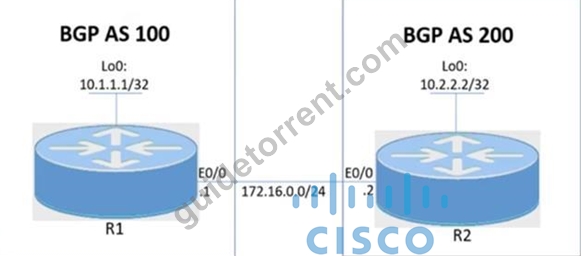
Tasks
R1 and R2 currently have an eBGP connection. Configure and verify these tasks on R1 and R2:
1. Apply the preconfigured route map R1-TO-R2 and R1 to receive the R2 Loopback address on R1.
2. Apply the preconfigured route map R2-TO-R1 and R2 to receive the R1 Loopback address on R1.
3. R1 must advertise network 10.1.1.1/32 toward R2. Redistribution is not allowed.
4. R2 must advertise network 10.2.2.2/32 toward R1. Redistribution is not allowed.
Answer:
Explanation:
R1:
router bgp 100
address-family ipv4
nei 172.16.0.2 route-map R1-TO-R2 in
network 10.1.1.1 mask 255.255.255.255
copy run start
R2:
router bgp 200
address-family ipv4
network 10.2.2.2 mask 255.255.255.255
nei 172.16.0.1 route-map R2-TO-R1 in
copy run start
NEW QUESTION # 183
When Cisco lOS XE REST API uses HTTP request methods what is the purpose of a PUT request?
- A. updates the specified resource with new information
- B. retrieves the specified resource or representation
- C. creates a new resource
- D. submits data to be processed to the specified resource
Answer: A
Explanation:
NEW QUESTION # 184
Refer to the exhibit: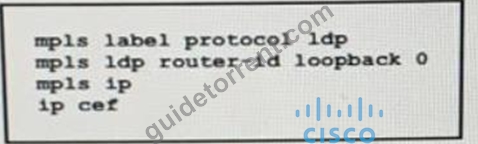
A network operator working for service provider with an employee id 3715 15:021 applied this configuration to a router.
Which additional step should the engineer use to enable LDP?
- A. Enable MPLS LDP on the interface
- B. Disable Cisco Express Forwarding globally
- C. Delete the static router ID
- D. Configure the both keyword to enable LDP globally
Answer: A
NEW QUESTION # 185
Refer to the exhibit: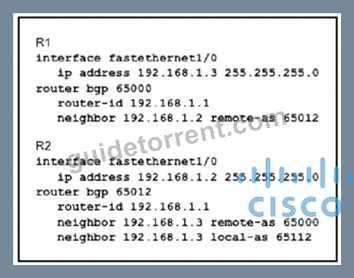
Assume all other configurations are correct and the network is otherwise operating normally. Which conclusion can you draw about the neighbor relationship between routers R1 and R2?
- A. The neighbor relationship is up
- B. The neighbor relationship will be up only if the two devices have activated the correct neighbor relationships under the IPv4 address family
- C. The neighbor relationship is down because the loco I-as value for R2 is missing in the R1 neighbor statement
- D. The neighbor relationship is down because R1 believes R2 is in AS 65012.
Answer: D
NEW QUESTION # 186
DRAG DROP
Drag and drop the multicast concepts from the left onto the correct descriptions on the right.
Select and Place: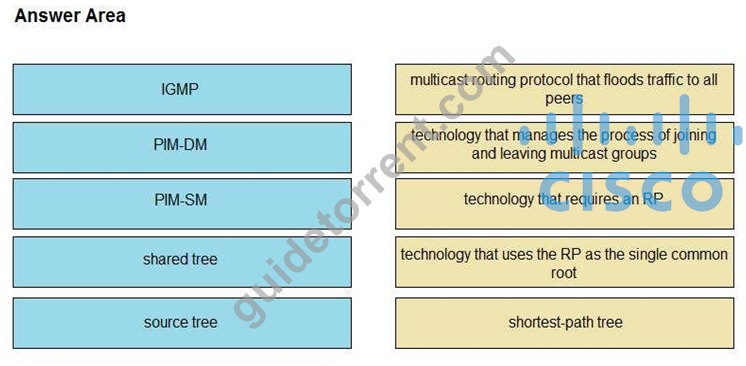
Answer:
Explanation: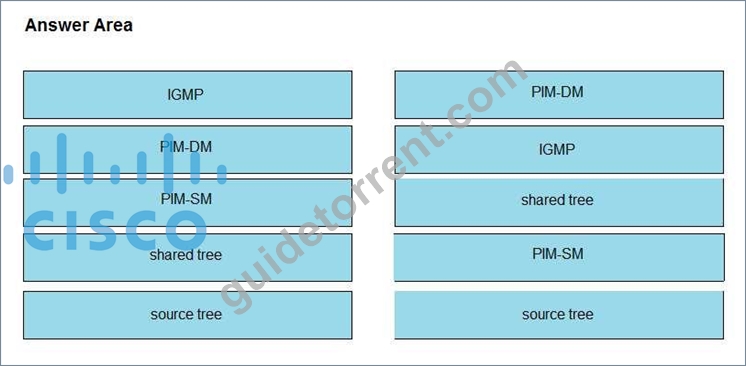
Section: Services
NEW QUESTION # 187
How does TI-LFA reduce packet loss in segment routing?
- A. It calculates loop-free backup paths that are rapidly implemented in case of a link failure.
- B. It determines which link to use when load balancing to prevent packet fragmentation loss.
- C. It establishes multiple labels per path using more than one IGP.
- D. It enables path selection in SR-TE to support MPLS label allocation.
Answer: A
Explanation:
TI-LFA (Topology Independent Loop-Free Alternate) reduces packet loss in segment routing by precomputing loop-free backup paths for each possible link or node failure. These backup paths are calculated using the network topology and are immediately implemented upon detection of a failure. This ensures near-instantaneous traffic rerouting without requiring full reconvergence of the IGP, significantly minimizing packet loss during failures.
NEW QUESTION # 188
Refer to the exhibit: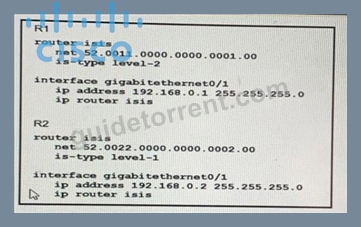
Which statement about the status of the neighbor relationship between R1 and R2 is true?
- A. The neighbor relationship is down because R2 is operating as a Level 1 router and the two routers are in different area
- B. The neighbor relationship is down because the two routers are configured with different area types
- C. The neighbor relationship is down because the two routers are in the same subnet.
- D. The neighbor relationship is up because R2 is level 1 and level 2 router.
Answer: C
NEW QUESTION # 189
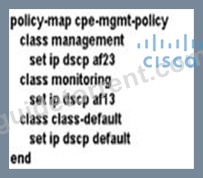
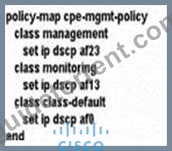
A network engineer Is implementing a QoS policy for outbound management traffic classification and marking on a CPE device with these requirements:
- Management protocols must be marked with DSCP AF class 2 w4h low drop probability.
- Monitoring protocols must be marked with DSCP AF class 1 with low
drop probability.
- All remaining traffic must be marked with a DSCP value of 0.
Which configuration must the engineer implement to satisfy the requirements?
- A.
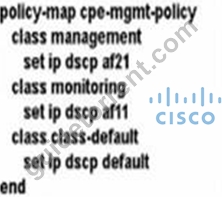
- B.
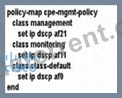
- C.
- D.
Answer: A
Explanation:
https://www.cisco.com/c/en/us/td/docs/switches/datacenter/nexus1000/sw/4_0/qos/configuration/ guide/nexus1000v_qos/qos_6dscp_val.pdf
NEW QUESTION # 190
Refer to the exhibit.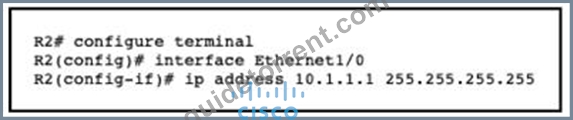
An engineer is configuring two routers to support MPLS LDP sessions between them. The R1 configuration is complete, and work has started on R2 as shown. Which additional configuration must the engineer apply to R2 to complete the task?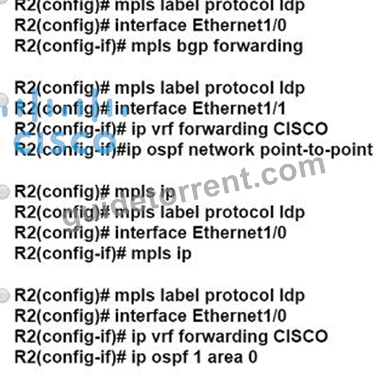
- A. Option B
- B. Option D
- C. Option A
- D. Option C
Answer: D
Explanation:
To establish MPLS LDP sessions between two routers, both routers must be configured to support MPLS on the interfaces that connect them. The configuration shown for R2 includes enabling MPLS label protocol LDP and configuring interfaces Ethernet1/0 and Ethernet1/1. However, to complete the MPLS LDP session setup, R2 also needs to have MPLS enabled on the interface toward R1. This is done by entering the interface configuration mode for the relevant interface and using the mpls ip command. This command enables MPLS forwarding for IP packets on the interface, which is necessary for LDP to advertise and map labels to the IP routes.
NEW QUESTION # 191
A router RP is configured to perform MPLS LDP graceful restart.
Which three steps are included when the RP sends an LDP initialization message to a neighbor to establish an LDP session? (Choose three.)
- A. Reconnect Timeout field
- B. Type-9 LSA
- C. Learn from Network (L) flag, set to 1
- D. Recovery Time field
- E. Learn from Neighbor (N) flag, set to 1
- F. Graceful restart capability in OPEN message
Answer: A,C,D
Explanation:
Section: MPLS and Segment Routing
Explanation/Reference: https://www.cisco.com/c/en/us/td/docs/ios-xml/ios/mp_ha/configuration/xe-16-8/mp-ha-xe-16-8- book/nsf-sso-mpls-ldp-and-ldp-graceful-restart.html
NEW QUESTION # 192
Refer to the exhibit.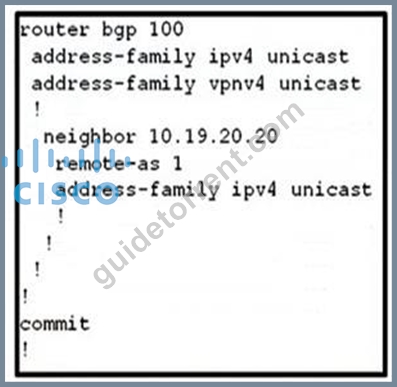
An engineer is trying to implement BGP configuration on a router. Which configuration error prevents the ASBR from establishing a BGP neighborship to a directly connected BGP speaker?
- A. The IPv4 address family configuration under neighbor configuration-mode must be removed.
- B. The VPNv4 address family interferes with the 8GP IPv4 address family negotiations.
- C. The TCP session parameters are not specified.
- D. The routing policy is absent for this Cisco IOS XR eBGP instance.
Answer: D
Explanation:
Explanation
https://www.cisco.com/c/en/us/td/docs/routers/xr12000/software/xr12k_r41/routing/configuration/guide/routing_ bgp router-id comes under TCP session parameters
NEW QUESTION # 193
Refer to the exhibit.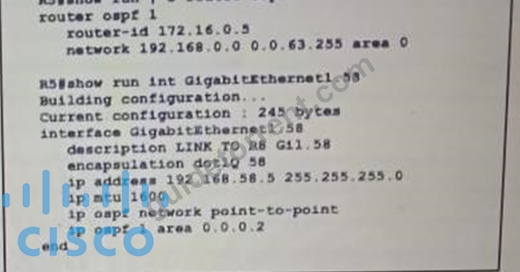
Which configuration must be implemented on router R8 so that it will establish OSPF adjacency with R5?
A)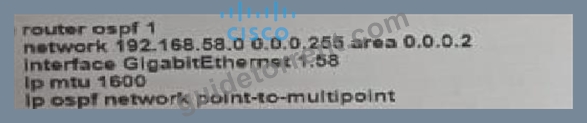
B)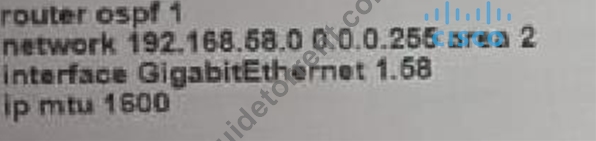
C)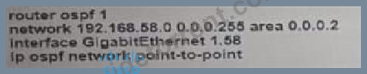
D)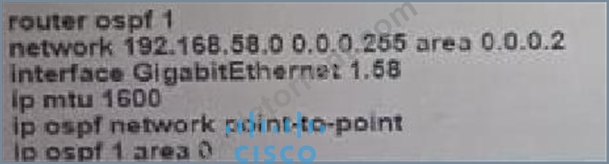
- A. Option B
- B. Option D
- C. Option C
- D. Option A
Answer: D
NEW QUESTION # 194
Refer to the exhibit.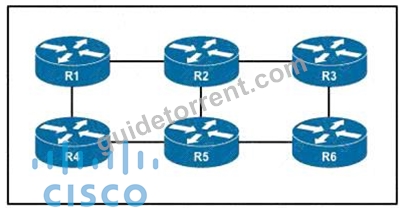
An engineer is configuring an administrative domain in the given multi-vendor environment with PIM-SM.
Which feature must the engineer implement so that devices will dynamically learn the RP?
- A. Auto-RP
- B. SSM
- C. BIDIR-PIM
- D. BSR
Answer: D
Explanation:
In a multi-vendor environment with PIM-SM, the Bootstrap Router (BSR) mechanism is used for devices to dynamically learn the Rendezvous Point (RP). BSR is a protocol feature that automates the dissemination of RP information in a PIM domain. This feature allows routers to automatically discover the RP set in use, which simplifies configuration and management compared to static RP configurations or Auto- RP. References: Implementing and Operating Cisco Service Provider Network Core Technologies source documents or study guide
NEW QUESTION # 195
An engineer is implementing MPLS to monitor within the MPLS domain. Which must the engineer perform to prevent packets from being forwarded beyond the service provider domain when the LSP is down?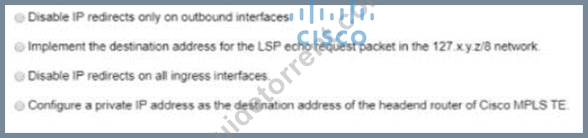
- A. Option B
- B. Option D
- C. Option A
- D. Option C
Answer: A
NEW QUESTION # 196
Refer to the exhibit.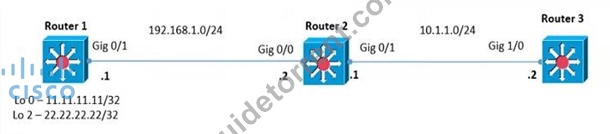
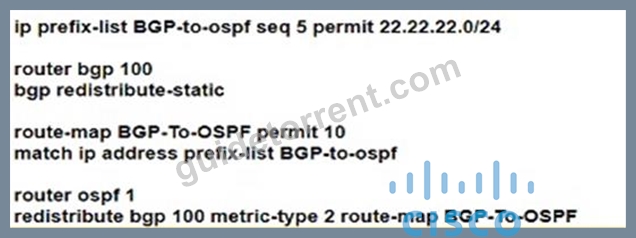
Router 1 and router 2 are running IBGP. and router 2 and router 3 are running OSPF Area 0. Router 1 is advertising loopback interlaces Lo0 and Lo2 and router 2 is redistributing BGP into OSPF Area 0. Which configuration must an administrator apply so that router 2 uses a route map to redistribute only the internal route from Lo 2?
A)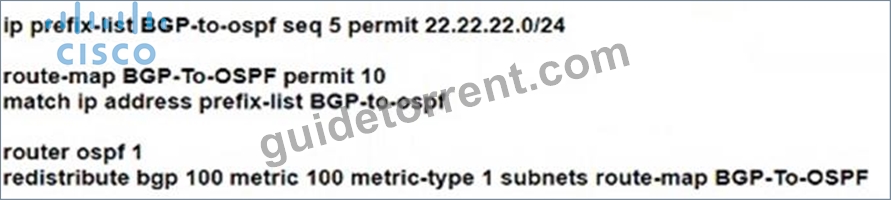
B)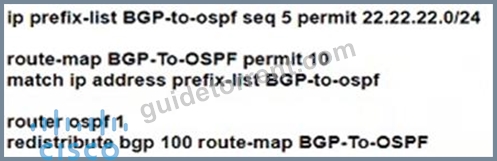
C)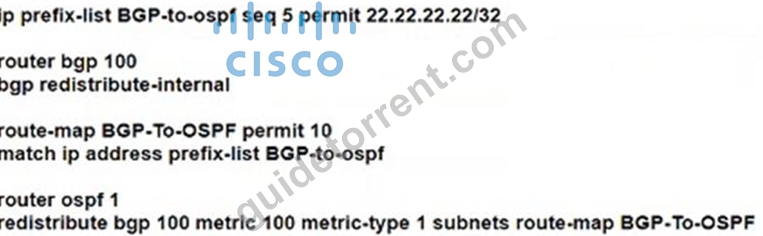
- A. Option B
- B. Option D
- C. Option A
- D. Option C
Answer: D
NEW QUESTION # 197
Which service is a VNF role?
- A. Storage
- B. Compute
- C. Network
- D. Firewall
Answer: D
Explanation:
A Virtual Network Function (VNF) role refers to a network function that is executed in software and can be deployed on a Network Functions Virtualization Infrastructure (NFVI). A firewall serves as a VNF role because it performs network functions, such as filtering traffic and security management, in software form rather than as a physical device.
NEW QUESTION # 198
......
Latest 350-501 Actual Free Exam Questions Updated 503 Questions: https://testking.guidetorrent.com/350-501-dumps-questions.html