
[2026] NCP-US-6.10 Actual Exam Dumps, NCP-US-6.10 Practice Test
GuideTorrent NCP-US-6.10 dumps & Nutanix Certified Professional (NCP) sure practice dumps
NEW QUESTION # 52
Which Nutanix Objects metric provides the total input requests per second of a bucket?
- A. Throughput
- B. NFS Reads
- C. Puts
- D. Gets
Answer: C
Explanation:
In Nutanix Objects metrics:
* Puts: Measures PUT requests per second (object uploads), representing input operations.
* Gets (Option C): Measures output (download) requests.
* Throughput (Option B): Reports bandwidth (MB/s), not request rate.
* NFS Reads (Option D): Specific to NFS access, not general bucket input.
Reference:Nutanix Objects Administration Guide:
"The Puts metric tracks the number of successful object write operations (PUTs) per second to a bucket, indicating input request volume."(Chapter: "Monitoring Object Store Performance") Nutanix Unified Storage (NCP-US) Study Material:
"Use the 'Puts' metric to monitor ingress request rates for capacity planning and performance tuning."(Section:
"Objects Performance Analysis")
NEW QUESTION # 53
An administrator needs to ensure the company has access to key information about their Nutanix Files deployment shares and files, such as Malicious Clients, Vulnerable Shares, and a list of potential ransomware attack attempts. What must be deployed on-premises to provide the monitoring needed to see this information?
- A. LCM dark site webserver
- B. Data Lens
- C. Prism Central
- D. File Analytics VM
Answer: D
Explanation:
To monitor key information about a Nutanix Files deployment, such asMalicious Clients,Vulnerable Shares
, and alist of potential ransomware attack attempts, the administrator must deploy theFile Analytics VM on-premises. Nutanix File Analytics is a dedicated virtual machine that provides advanced monitoring and analytics for Nutanix Files, offering insights into security-related activities, including malicious client behavior, share vulnerabilities, and ransomware detection.
TheNutanix Unified Storage Administration (NUSA)course states, "File Analytics is a VM that must be deployed on-premises to provide detailed monitoring of Nutanix Files, including identifying Malicious Clients, Vulnerable Shares, and potential ransomware attack attempts through its analytics and anomaly detection features." File Analytics includes dashboards and widgets that specifically highlight security risks, such as the Malicious Clients list (clients exhibiting suspicious behavior), Vulnerable Shares (shares with overly permissive access), and ransomware detection (based on file activity patterns like mass encryption or renaming).
TheNutanix Certified Professional - Unified Storage (NCP-US)study guide further elaborates that
"deploying the File Analytics VM enables administrators to monitor Nutanix Files for security threats, providing visibility into Malicious Clients, Vulnerable Shares, and ransomware attempts through its integrated analytics engine." File Analytics runs locally within the Nutanix cluster, making it suitable for on-premises deployments and capable of operating in isolated environments like dark sites.
The other options are incorrect:
* LCM dark site webserver: An LCM dark site webserver is used to host software updates for LCM in air-gapped environments but does not provide monitoring or analytics for Nutanix Files.
* Prism Central: Prism Central provides centralized management and monitoring for Nutanix clusters but does not offer the specific security-focused analytics (e.g., Malicious Clients, ransomware detection) that File Analytics provides for Nutanix Files.
* Data Lens: Nutanix Data Lens is a cloud-based service for data lifecycle management and analytics, primarily for Nutanix Objects and Files, but it focuses on tiering and data placement, not security monitoring like ransomware detection or malicious clients.
The NUSA course documentation emphasizes that "the File Analytics VM is the essential on-premises component for monitoring Nutanix Files, providing critical security insights such as Malicious Clients, Vulnerable Shares, and ransomware attack attempts." References:
Nutanix Unified Storage Administration (NUSA) Course, Section on File Analytics: "Deploying File Analytics VM for security monitoring." Nutanix Certified Professional - Unified Storage (NCP-US) Study Guide, Topic 3: Analyze and Monitor Nutanix Unified Storage, Subtopic: "File Analytics for Nutanix Files security insights." Nutanix Documentation (https://www.nutanix.com), Nutanix File Analytics Guide: "Monitoring Malicious Clients, Vulnerable Shares, and ransomware attempts."
NEW QUESTION # 54
Question:
A Nutanix Files cluster isunreachableafter an administrator changed itsname.
What should the administrator do to solve the problem?
- A. Restart CVMs to apply the changes.
- B. Delete active user sessions from Files.
- C. Delete old and add new DNS entries.
- D. Restart FSVMs to apply the changes.
Answer: C
Explanation:
Changing thename of a Nutanix Files clusterinvolves updating theDNS name resolutionfor its FSVMs and VIPs. When the cluster's name changes:
The underlying IP addresses (CVMs, FSVMs, VIPs)do not change.
However,DNS entriesassociated with the old cluster namebecome outdated, causing clients (including management interfaces and file share connections) to fail to resolve the new name to the correct IP addresses.
From the NUSA course troubleshooting section:
"After renaming a Files cluster, update the DNS entries to reflect the new name. Otherwise, clients and administrators will be unable to reach the cluster resources." Restarting CVMs or FSVMs does not update DNS entries.
Deleting active user sessions won't fix the DNS resolution problem.
Therefore, to resolve theunreachabilityissue, the administrator must:
#Delete old DNS entriesfor the previous cluster name.
#Add new DNS entriesmapping the new cluster name to the same IPs of the FSVMs and VIP.
This ensures that all systems can properly resolve the new cluster name and reach the Nutanix Files services.
NEW QUESTION # 55
An administrator manages a three-node AHV cluster running Nutanix Files and is attempting a Files scale-out operation on a multi-node FSVM deployment. However, the operation has failed. What should the administrator do first?
- A. Expand the AHV cluster
- B. Add RAM to the physical hosts
- C. Add DNS entries
- D. Failover to secondary site
Answer: A
Explanation:
The administrator is attempting to scale out a Nutanix Files deployment by adding more File Server Virtual Machines (FSVMs) to a multi-node FSVM deployment on a three-node AHV cluster, but the operation has failed. The first step the administrator should take is toexpand the AHV cluster. Nutanix Files requires a minimum number of nodes in the cluster to support a scale-out operation, and a three-node cluster may not have sufficient resources (nodes) to accommodate additional FSVMs.
TheNutanix Unified Storage Administration (NUSA)course states, "Nutanix Files scale-out operations require sufficient cluster nodes to host additional FSVMs, and a minimum of four nodes is recommended for scaling out a multi-node FSVM deployment." In a three-node cluster, each node typically hosts one FSVM (for a total of three FSVMs), and scaling out to add more FSVMs requires additional nodes to distribute the new FSVMs. If the cluster does not have enough nodes, the scale-out operation will fail, as there are no available nodes to host the new FSVMs.
TheNutanix Certified Professional - Unified Storage (NCP-US)study guide further elaborates that "when a Nutanix Files scale-out operation fails on a small cluster, the first step is to verify the cluster size and expand the AHV cluster by adding more nodes to support the additional FSVMs." Expanding the cluster to at least four nodes provides the necessary capacity to host a new FSVM, allowing the scale-out operation to succeed.
The other options are incorrect:
* Add RAM to the physical hosts: While insufficient RAM could cause issues, the failure of a scale-out operation is more likely due to a lack of nodes rather than RAM, especially since FSVMs have specific node placement requirements.
* Failover to secondary site: Failover to a secondary site is relevant for disaster recovery (e.g., using Smart DR), not for resolving a scale-out failure within the primary cluster.
* Add DNS entries: DNS entries may be needed for client access to Nutanix Files, but they are not directly related to the scale-out operation of FSVMs within the cluster.
The NUSA course documentation emphasizes that "a common cause of Nutanix Files scale-out failures in small clusters is insufficient nodes; expanding the AHV cluster to at least four nodes is the first step to ensure successful scaling." References:
Nutanix Unified Storage Administration (NUSA) Course, Section on Nutanix Files: "Scaling out Nutanix Files and cluster requirements." Nutanix Certified Professional - Unified Storage (NCP-US) Study Guide, Topic 4: Troubleshoot Nutanix Unified Storage, Subtopic: "Troubleshooting Nutanix Files scale-out failures." Nutanix Documentation (https://www.nutanix.com), Nutanix Files Administration Guide: "Cluster sizing for Nutanix Files scale-out operations."
NEW QUESTION # 56
An administrator has configured two object store instances, one in New York and the other in London. Both object stores are managed by their own Prism Central instances running compatible versions. Availability zone pairing and IAM replication has been configured between Prism Central instances; the implementation requires a common namespace. Which action should the administrator take next?
- A. Create a Global Namespace
- B. Create a File System Namespace
- C. Create a Kubernetes Namespace
- D. Create a Federated Namespace
Answer: A
Explanation:
To meet the requirement of acommon namespacefor two Nutanix Objects instances located in New York and London, managed by separate Prism Central instances with availability zone pairing and IAM replication, the administrator shouldcreate a Global Namespace. A global namespace in Nutanix Objects allows multiple object store instances to share a unified namespace, enabling consistent access to buckets and objects across geographically distributed sites using a single naming convention.
TheNutanix Unified Storage Administration (NUSA)course explains that "Nutanix Objects supports a global namespace to provide a unified view of buckets across multiple object store instances, which is critical for distributed environments requiring consistent data access." This feature ensures that applications and users can access objects using the same bucket names and paths, regardless of the physical location of the object store (e.g., New York or London). The global namespace is particularly useful in scenarios involving availability zone pairing, where data consistency and accessibility across regions are required.
TheNutanix Certified Professional - Unified Storage (NCP-US)study guide further details that "enabling a global namespace in Nutanix Objects requires configuring the object stores to share a common namespace, which is supported when Prism Central instances are paired for availability zones and IAM replication is enabled." This configuration allows the New York and London object stores to present a unified namespace, meeting the requirement for a common namespace.
The other options are incorrect:
* Create a Federated Namespace: Nutanix Objects does not use the term "Federated Namespace." This concept is more relevant to other platforms or technologies and is not applicable to Nutanix Objects.
* Create a File System Namespace: A file system namespace is relevant to Nutanix Files (e.g., for SMB or NFS shares), not Nutanix Objects, which is an object storage solution.
* Create a Kubernetes Namespace: A Kubernetes namespace is used to organize resources in a Kubernetes cluster and is unrelated to Nutanix Objects or its namespace requirements.
The NUSA course documentation notes that "a global namespace in Nutanix Objects is configured through Prism Central, leveraging availability zone pairing and IAM replication to ensure consistent bucket naming and access across distributed object stores." The administrator should configure the global namespace in the Nutanix Objects settings for both the New York and London instances, ensuring that the Prism Central instances are properly paired and IAM replication is active.
References:
Nutanix Unified Storage Administration (NUSA) Course, Section on Nutanix Objects: "Configuring global namespace for distributed object stores." Nutanix Certified Professional - Unified Storage (NCP-US) Study Guide, Topic 2: Configure and Utilize Nutanix Unified Storage, Subtopic: "Nutanix Objects global namespace and availability zone pairing." Nutanix Documentation (https://www.nutanix.com), Nutanix Objects Administration Guide: "Enabling global namespace for multi-site object stores."
NEW QUESTION # 57
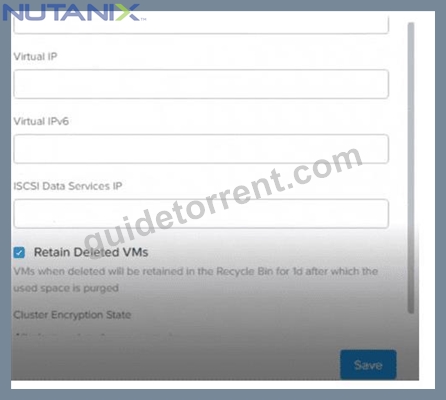
Exhibit: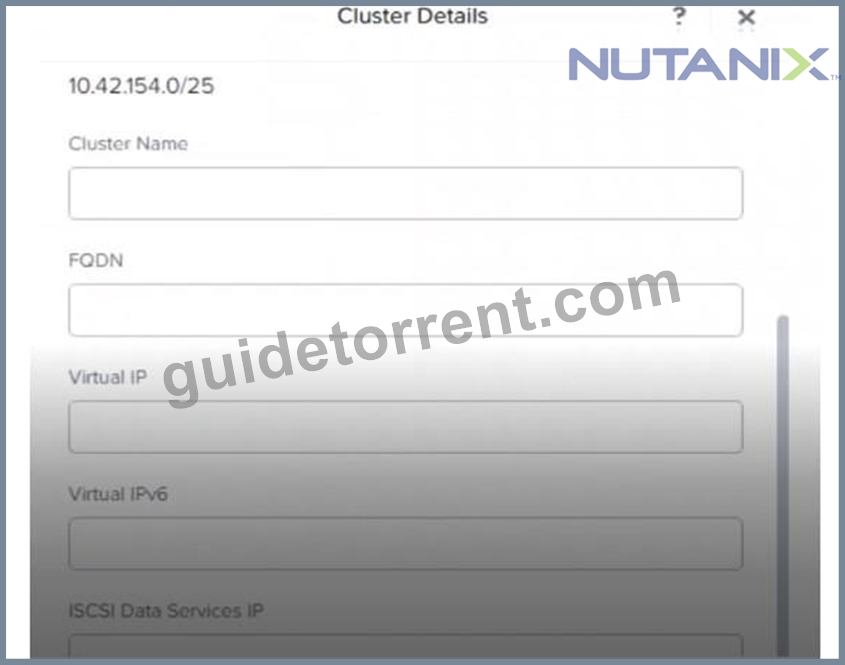
An administrator is enabling Nutanix Volumes for use with workloads within a Nutanix-based environment.
Based on the exhibit, which field is required by Nutanix Volumes to be populated?
- A. Virtual IP
- B. FQDN
- C. Virtual IPv6
- D. iSCSI Data Services IP
Answer: D
Explanation:
The exhibit shows the "Cluster Details" page in a Nutanix Prism interface, displaying fields such as Cluster Name, FQDN, Virtual IP, Virtual IPv6, and iSCSI Data Services IP. The administrator is enabling Nutanix Volumes, which is a block storage service that provides iSCSI-based storage for workloads. Nutanix Volumes allows external hosts or VMs to connect to the Nutanix cluster via iSCSI, requiring a specific IP address for iSCSI communication.
According to theNutanix Unified Storage Administration (NUSA)course, "Nutanix Volumes requires the iSCSI Data Services IP to be configured in the cluster settings to enable iSCSI connectivity for external hosts or workloads." The iSCSI Data Services IP is a dedicated IP address used by the Nutanix cluster to handle iSCSI traffic, ensuring that iSCSI initiators (clients) can connect to the cluster and access block storage volumes. This field must be populated to enable Nutanix Volumes functionality, as it serves as the endpoint for iSCSI communication.
TheNutanix Certified Professional - Unified Storage (NCP-US)study guide further elaborates that "the iSCSI Data Services IP is a mandatory field when enabling Nutanix Volumes, as it defines the IP address that external iSCSI initiators use to connect to the cluster for block storage access." Without this IP address, Nutanix Volumes cannot function, as there would be no designated network endpoint for iSCSI traffic.
In the exhibit, the "iSCSI Data Services IP" field is present, indicating its relevance to Nutanix Volumes configuration. The other fields are not mandatory for enabling Nutanix Volumes:
* FQDN (Fully Qualified Domain Name): The FQDN is optional and used for resolving the cluster's name in DNS. It is not required for Nutanix Volumes to function, as iSCSI connectivity relies on IP addresses, not DNS names.
* Virtual IPv6: This field is for configuring a Virtual IP using IPv6 for cluster management access (e.g., Prism GUI). Nutanix Volumes does not require IPv6; the iSCSI Data Services IP typically uses IPv4, and IPv6 support is optional.
* Virtual IP: The Virtual IP (IPv4) is used for accessing the Prism GUI and other cluster management services. While recommended for cluster management, it is not specifically required for Nutanix Volumes, as iSCSI traffic uses the iSCSI Data Services IP.
The NUSA course documentation emphasizes that "configuring the iSCSI Data Services IP is a prerequisite for enabling Nutanix Volumes, ensuring that iSCSI initiators can connect to the cluster for block storage operations." The administrator must populate this field with a valid IP address from the cluster's network to enable Nutanix Volumes successfully.
References:
Nutanix Unified Storage Administration (NUSA) Course, Section on Nutanix Volumes: "Configuring iSCSI Data Services IP for Nutanix Volumes." Nutanix Certified Professional - Unified Storage (NCP-US) Study Guide, Topic 2: Configure and Utilize Nutanix Unified Storage, Subtopic: "Nutanix Volumes setup and iSCSI configuration." Nutanix Documentation (https://www.nutanix.com), Nutanix Volumes Administration Guide: "Enabling Nutanix Volumes and configuring iSCSI Data Services IP."
NEW QUESTION # 58
An administrator is tasked with migrating physical SQL workloads from a legacy SAN platform to a newly- deployed Nutanix environment. The current physical hosts boot from SAN. The Nutanix environment has plenty of storage resources available. Which action can the administrator take to complete this task?
- A. Boot over iSCSI using Nutanix Volumes
- B. Boot using Nutanix Object stores
- C. Boot using PXE protocol with Nutanix Files
- D. Boot using the NFS protocol with Nutanix Files
Answer: A
Explanation:
To migrate physical SQL workloads from a legacy SAN platform where hosts boot from SAN to a Nutanix environment, the administrator can useNutanix Volumesto enable booting overiSCSI. Nutanix Volumes is a block storage solution that provides iSCSI-based storage, allowing external hosts (such as physical servers) to access Nutanix storage as block devices. This is ideal for replacing SAN-based boot volumes, as it supports the same iSCSI protocol used in traditional SAN environments.
According to theNutanix Unified Storage Administration (NUSA)course, Nutanix Volumes enables external hosts to connect to Nutanix storage via iSCSI, which can be used for boot volumes or data volumes.
The course emphasizes that "Nutanix Volumes supports iSCSI boot for physical servers, making it a suitable solution for migrating workloads from legacy SAN environments to Nutanix." This allows the administrator to configure the physical SQL servers to boot from iSCSI targets provisioned on Nutanix Volumes, leveraging the Nutanix cluster's storage resources.
TheNutanix Certified Professional - Unified Storage (NCP-US)study guide further details that Nutanix Volumes can be configured to present iSCSI LUNs to physical hosts, which can be used for both operating system boot and application data storage. For the SQL workloads, the administrator can create iSCSI targets on Nutanix Volumes, configure the physical hosts' iSCSI initiators to connect to these targets, and migrate the boot and data volumes from the legacy SAN to Nutanix.
The other options are not suitable for this task:
* Boot using PXE protocol with Nutanix Files: Nutanix Files is a file storage solution that supports SMB and NFS protocols, not PXE (Preboot Execution Environment) booting. PXE is typically used for network-based OS installation, not for booting SQL workloads or replacing SAN-based boot volumes.
* Boot using the NFS protocol with Nutanix Files: Nutanix Files supports NFS for file sharing, but NFS is not designed for booting physical servers. It is used for file-level access, not block-level access required for boot volumes.
* Boot using Nutanix Object stores: Nutanix Objects is an object storage solution designed for S3- compatible APIs, not for block or file-based booting. It is unsuitable for hosting bootable volumes or SQL workloads.
The NUSA course documentation highlights that "Nutanix Volumes provides a seamless migration path for SAN-based workloads, including boot-from-SAN configurations, by leveraging iSCSI to present storage to physical hosts." This makes it the only viable option for the described migration task.
References:
Nutanix Unified Storage Administration (NUSA) Course, Section on Nutanix Volumes: "Configuring iSCSI for external hosts and boot volumes." Nutanix Certified Professional - Unified Storage (NCP-US) Study Guide, Topic 1: Deploy and Upgrade Nutanix Unified Storage, Subtopic: "Nutanix Volumes for SAN workload migration." Nutanix Documentation (https://www.nutanix.com), Nutanix Volumes Administration Guide: "Using iSCSI for boot and data volumes."
NEW QUESTION # 59 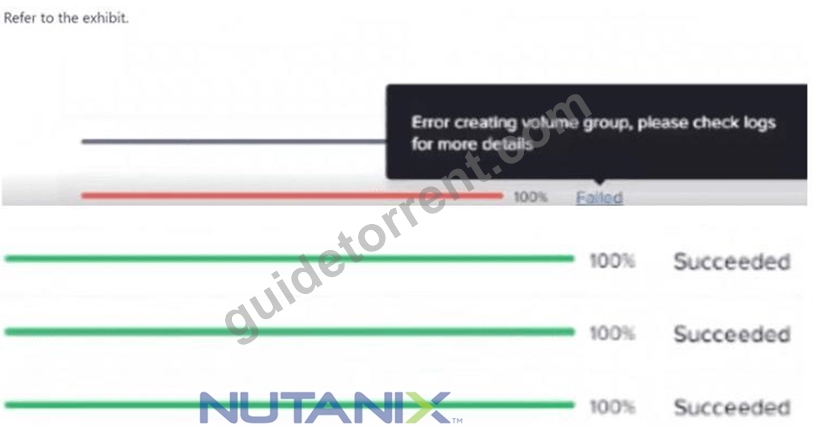
Question:
An administrator is deployingFile Analytics. The following subnets are available:
* CVM subnet: 10.1.1.0/24
* AHV subnet: 10.1.2.0/24
* Nutanix Files client network: 10.1.3.0/24
* Nutanix Files storage network: 10.1.4.0/24
The administrator has reserved10.1.4.100as the File Analytics IP. However, the deploymentfailswith the error shown:
"Error creating volume group, please check logs for more details."
What action must the administrator take to successfully deploy File Analytics?
- A. Allow port 445 in the firewall.
- B. Re-deploy File Analytics on the Files client network.
- C. Allow port 139 in the firewall.
- D. Re-deploy File Analytics on the Files storage network.
Answer: B
Explanation:
According to the NUSA course materials,File Analyticsis designed to be deployed on thesame networkas the Nutanix Filesclient networkbecause:
File Analyticsaccesses file share metadata and analytics datathrough the same SMB/NFS protocolsused by clients accessing the shares.
Using theclient networkensures that File Analytics canconnect to the SMB/NFS endpoints, collect activity logs, and provide visibility without traversing storage-only traffic.
Using thestorage network(as was done with IP 10.1.4.100 in this case) leads to deployment errors because:
"The storage network in Nutanix Files is used exclusively for data replication and cluster-level operations- not for client or analytics traffic. Using this network for File Analytics deployment causes communication failures." Thus, the administrator mustredeploy File Analytics on the Files client network (10.1.3.0/24), ensuring proper access and connectivity.
The firewall port configuration (ports 445/139) is relevant for SMB traffic butnotthe root cause of the deployment error in this case.
NEW QUESTION # 60
An administrator has determined that adding File Server VMs to the cluster will provide more resources.
What must the administrator validate so that the new File Server VMs can be added?
- A. Sufficient storage container space is available to host the volume groups.
- B. Sufficient nodes in the cluster is greater than current number of FSVMs.
- C. Ensure network ports are available.
- D. Ensure Files Analytics is installed.
Answer: B
Explanation:
Comprehensive and Detailed Explanation from Nutanix Unified Storage (NCP-US) and Nutanix Unified Storage Administration (NUSA) course documents:
In the context of expanding Nutanix Files (which is the file services capability of Nutanix Unified Storage), adding additionalFile Server VMs (FSVMs)to the cluster allows the file service to scale out and provide more resources for file services workloads, including performance and capacity improvements.
The Nutanix Files architecture involves deploying FSVMs that are distributed across the cluster nodes. Each FSVM handles file protocol operations and interacts with the underlying Nutanix Distributed Storage Fabric (DSF).
Here's what's critical when adding new FSVMs:
* Sufficient Cluster Nodes Requirement:The Nutanix Unified Storage Administration (NUSA) course emphasizes that thenumber of FSVMs cannot exceed the number of physical nodes in the cluster.
This is because each FSVM is deployed as a VM on a physical node, and Nutanix best practices require that FSVMs be spread out evenly across available nodes for performance, load balancing, and resiliency. Therefore, you must ensure:
"The number of nodes in the cluster must be greater than or equal to the number of FSVMs you plan to deploy." This ensures that FSVMs are properly balanced and have the physical resources they need for optimal operation.
* Network Ports:While ensuring that appropriate network ports are configured is important for the operation of Nutanix Files (including communication with clients via SMB/NFS and integration with Prism), it isnotthe gating factor for adding new FSVMs. The critical factor is theavailable cluster nodes.
* Storage Container Space:Storage container space is also essential for file data storage, but this is not a direct requirement when simply adding FSVMs. FSVMs use the existing DSF storage, and as long as there is available storage capacity overall, adding FSVMs does not require validating specific volume group space.
* Files Analytics:Files Analytics is an optional feature that provides advanced analytics for file shares, such as usage patterns and security insights. It isnot requiredto add new FSVMs.
* Design Best Practices:In the NUSA course, administrators are taught to always validate the number of cluster nodes first before deploying additional FSVMs. This ensures that the cluster can accommodate the new FSVMs without causing resource contention or violating best practice guidelines for balanced and resilient file server deployments.
* Resilience and High Availability:Because FSVMs are distributed across the physical cluster nodes, having more nodes than FSVMs ensures that if a node fails, the FSVMs can failover to other available nodes. This helps maintain the high availability of file services.
In summary, while other factors like network ports, container space, and analytics capabilities play roles in the broader operation and management of Nutanix Files, theabsolute requirement for adding FSVMs is ensuring that there are enough cluster nodes to host them. This ensures compliance with design best practices for scalability and resilience, as emphasized in the official Nutanix training courses.
NEW QUESTION # 61
An administrator has files located in shares, buckets, and volumes. In which environment can File Analytics be used to collect metadata?
- A. CHAP authenticated iSCSI
- B. AD authenticated SMB
- C. Kerberos authenticated S3
- D. Kerberos authenticated NFS v4.0
Answer: B
Explanation:
File Analytics (part of Data Lens) collects metadata only for AD-authenticated SMB shares. It scans file attributes (size, owner, extensions) for analysis.
* Options A/B: Object buckets (S3) and NFS shares are unsupported.
* Option C: iSCSI Volumes use block storage; file-level metadata is inaccessible.
Reference:Nutanix Data Lens Administration Guide:
"File Analytics supports SMB shares joined to Active Directory. Metadata collection requires AD permissions for file scanning."(Chapter: "Supported Protocols")Nutanix NCP-US Study Material:"File Analytics is exclusive to AD-authenticated SMB shares; object/block storage and NFS are incompatible." (Section: "Data Lens Capabilities")
NEW QUESTION # 62
Which component is a prerequisite for deploying Nutanix Files?
- A. A minimum of two vCPUs
- B. iSCSI Data Services IP
- C. Prism Central
- D. Storage Container
Answer: D
Explanation:
Storage Containers are mandatory for Nutanix Files because:
* They provide the underlying storage pool for file shares.
* Define replication factor, compression, and encryption settings.
Other options are incorrect:
* A: vCPUs are per-File-Server-VM specs (#4 vCPUs required).
* B: Prism Central is needed for management but not core deployment.
* D: iSCSI IPs relate to Nutanix Volumes, not Files.
Reference:Nutanix Files Deployment Guide:
"Before deploying Files, create a Storage Container to host share data. This container must have RF#2 and erasure coding disabled."(Chapter: "Prerequisites") Nutanix Unified Storage Administration (NUSA) Course:
"Storage Containers are foundational prerequisites; all file data resides in these logical pools."(Module: "Files Installation Fundamentals")
NEW QUESTION # 63
An administrator is setting a Windows client to access a Volume Group (VG) served by a Nutanix cluster.
Which configuration items should the administrator take from the cluster? (Choose two.)
- A. The IPs of all cluster CVMs IP
- B. The VG name
- C. The cluster's data services IP (DSIP)
- D. The cluster's fully qualified domain name (FQDN)
Answer: B,C
Explanation:
When setting up a Windows client to access aVolume Group (VG)via iSCSI, the administrator must configure the client's iSCSI initiator to connect to the correcttarget.
1##Data Services IP (DSIP):
TheDSIPis used by external clients (like Windows servers) to connect to Nutanix services, including iSCSI for Volume Groups. It's a highly available IP that floats across the cluster CVMs.
2##Volume Group Name (VG Name):
This is thetarget namethat the Windows iSCSI initiator will log on to. It's needed to identify which Volume Group to access.
The cluster's FQDN or all CVM IPs aren't used for direct iSCSI target connections. TheDSIPensures proper load balancing and failover for the connection, while theVG nameis essential to identify the specific storage being requested.
NEW QUESTION # 64
Refer to the exhibit:
```
192.168.5.1> get-smbclient configuration
ConnectionCountPerRssNetworkInterface: 4
DirectoryCacheEntriesMax: 16
DirectoryCacheEntrySizeMax: 65536
DirectoryCacheLifetime: 10
EnableBandwidthThrottling: True
EnableByteRangeLockingOnReadOnlyFiles: True
EnableLargeMtu: True
EnableMultiChannel: True
DormantFileLimit: 1023
EnableSecuritySignature: True
ExtendedSessionTimeout: 1000
EnableSecuritySignature: True
ExtendedSessionTimeout: 1000
FileInfoCacheEntriesMax: 64
FileInfoCacheLifetime: 10
FileNotFoundCacheEntriesMax: 128
FileNotFoundCacheLifetime: 5
KeepConn: 600
MaxCmds: 50
MaximumConnectionCountPerServer: 32
OplocksDisabled: False
RequireSecuritySignature: True
SessionTimeout: 60
UseOpportunisticLocking: True
WindowSizeThreshold: 1
```
An administrator is unable to browse a share and runs the `get-smbclient configuration` command. What is a possible cause of the problem indicated by the `RequireSecuritySignature` line?
- A. Kerberos is enabled
- B. TLS is enabled
- C. CHAP is enabled
- D. AD is enabled
Answer: A
Explanation:
The exhibit shows the output of the `get-smbclient configuration` command on a Nutanix Files system, with the line `RequireSecuritySignature: True` highlighted as a potential cause for the administrator's inability to browse an SMB share. The setting `RequireSecuritySignature: True` indicates that the SMB client requires security signatures (also known as SMB signing) for all SMB communications, which ensures data integrity and authenticity. A possible cause of the browsing issue related to this setting is that **Kerberos is enabled**, as Kerberos authentication is often required when SMB signing is enforced, especially in Active Directory (AD) environments.
The **Nutanix Unified Storage Administration (NUSA)** course explains that "in Nutanix Files, when
`RequireSecuritySignature` is set to True, SMB signing is mandatory, and this often relies on Kerberos authentication to provide the necessary security tokens for signing SMB packets." Kerberos is the default authentication protocol in AD environments, and Nutanix Files integrates with AD for SMB share access. If the client attempting to browse the share does not support Kerberos or has issues with Kerberos authentication (e.g., misconfigured AD, time sync issues, or lack of domain credentials), the SMB connection may fail, resulting in the inability to browse the share.
The **Nutanix Certified Professional - Unified Storage (NCP-US)** study guide further elaborates that
"enabling `RequireSecuritySignature` in Nutanix Files often requires Kerberos authentication to be properly configured, as SMB signing uses Kerberos tickets to secure communication, and mismatches in Kerberos settings can prevent share access." The administrator should verify that the client is domain-joined, Kerberos is functioning correctly (e.g., by checking time sync between the client, Nutanix Files, and the AD domain controller), and that the necessary Kerberos tickets are available.
The other options are incorrect:
- **AD is enabled**: While AD is typically enabled in environments where SMB signing and Kerberos are used, simply enabling AD does not directly cause the issue. The problem is more specifically tied to Kerberos, which is the authentication mechanism AD uses.
- **TLS is enabled**: TLS (Transport Layer Security) is not directly related to SMB signing. SMB signing operates at the SMB protocol level, while TLS would apply to network-layer encryption, which is not indicated in the configuration output.
- **CHAP is enabled**: CHAP (Challenge-Handshake Authentication Protocol) is used for protocols like iSCSI or PPP, not SMB, and is irrelevant to this issue.
The NUSA course documentation emphasizes that "if `RequireSecuritySignature` is enabled and users cannot browse SMB shares, administrators should check Kerberos authentication settings, as mismatches or failures in Kerberos can prevent successful SMB connections." References:
- Nutanix Unified Storage Administration (NUSA) Course, Section on Nutanix Files: "Troubleshooting SMB share access with security signatures."
- Nutanix Certified Professional - Unified Storage (NCP-US) Study Guide, Topic 4: Troubleshoot Nutanix Unified Storage, Subtopic: "Diagnosing SMB connection issues with `RequireSecuritySignature`."
- Nutanix Documentation (https://www.nutanix.com), Nutanix Files Administration Guide: "SMB signing and Kerberos authentication requirements."
---
NEW QUESTION # 65
Question: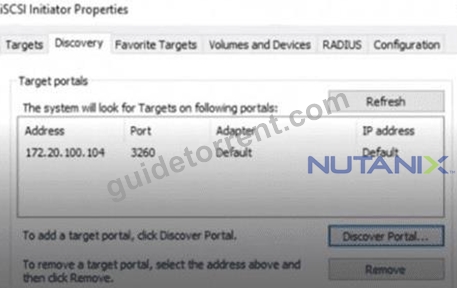
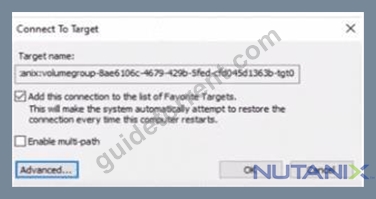
An administrator has received a complaint from a user that a Windows VM lost access to an iSCSI Volume Group (VG) during a maintenance window of an ESXi-based Nutanix cluster. The VM's iSCSI configuration shows it is connecting to a specific IP (172.20.100.104).
What recommended change should the administrator make to resolve this disruption?
- A. Select the Enable multi-path checkbox.
- B. Add all missing CVM IPs in Discovery tab.
- C. Remove Discovery IP and configure with DSIP.
- D. Change the Discovery IP to match the configured VIP.
Answer: C
Explanation:
When configuring iSCSI connections to Nutanix Volume Groups (VGs), Nutanix recommends using theData Services IP (DSIP)as the discovery IP in the iSCSI Initiator configuration. Here's why:
TheDSIP (172.20.100.50)in this environment is designed to be highly available andfloats across CVMs within the Nutanix cluster.
The DSIP automatically handles failover between CVMs during maintenance, software upgrades, or node failures.
Configuring the iSCSI initiator withindividual CVM IPs (like 172.20.100.104)is not recommended because:
* If the CVM goes down (maintenance, upgrade, etc.), the initiator willlose connectionto the volume group, causing the exact issue seen here.
The NUSA and NCP-US course materials specifically emphasize:
"The Data Services IP should be used as the discovery target for iSCSI Volume Groups to ensure automatic failover and eliminate connection disruptions during maintenance windows." VIPis used formanagement traffic(Prism Central/Prism Element) and is not used for iSCSI.
Enable multi-pathis important for performance but does not resolve this misconfigured discovery IP issue.
Adding all CVMsindividually also doesn't provide automated failover and isn't a best practice.
Thus, the fix is toremove the CVM IP (172.20.100.104) and configure the Windows iSCSI initiator with the DSIP (172.20.100.50)as the discovery target.
NEW QUESTION # 66
Question:
An administrator needs to configure Nutanix Objects in AHV.
Which IP range must be available for this task?
- A. 10.100.1.0/24
- B. 10.100.0.0/16 and 10.200.0.0/16
- C. 172.100.0.0/16 and 172.200.0.0/16
- D. 192.168.1.0/24
Answer: B
Explanation:
When deploying Nutanix Objects, internal communication and data flow between Object services are isolated usinginternal overlay IP rangesto avoid collisions with existing customer networks.
The NCP-US and NUSA course materials state:
"Nutanix Objects requires two separate internal IP address ranges: 10.100.0.0/16 and 10.200.0.0/16. These ranges are used exclusively for internal communication within the Nutanix Objects deployment, such as for object metadata, S3 gateway, and load balancing services."
* These10.x.x.x rangesmust not overlap with existing client or management networks.
* They provide fully isolated internal object service communication.
NEW QUESTION # 67
......
NCP-US-6.10 Actual Questions and Braindumps: https://testking.guidetorrent.com/NCP-US-6.10-dumps-questions.html